
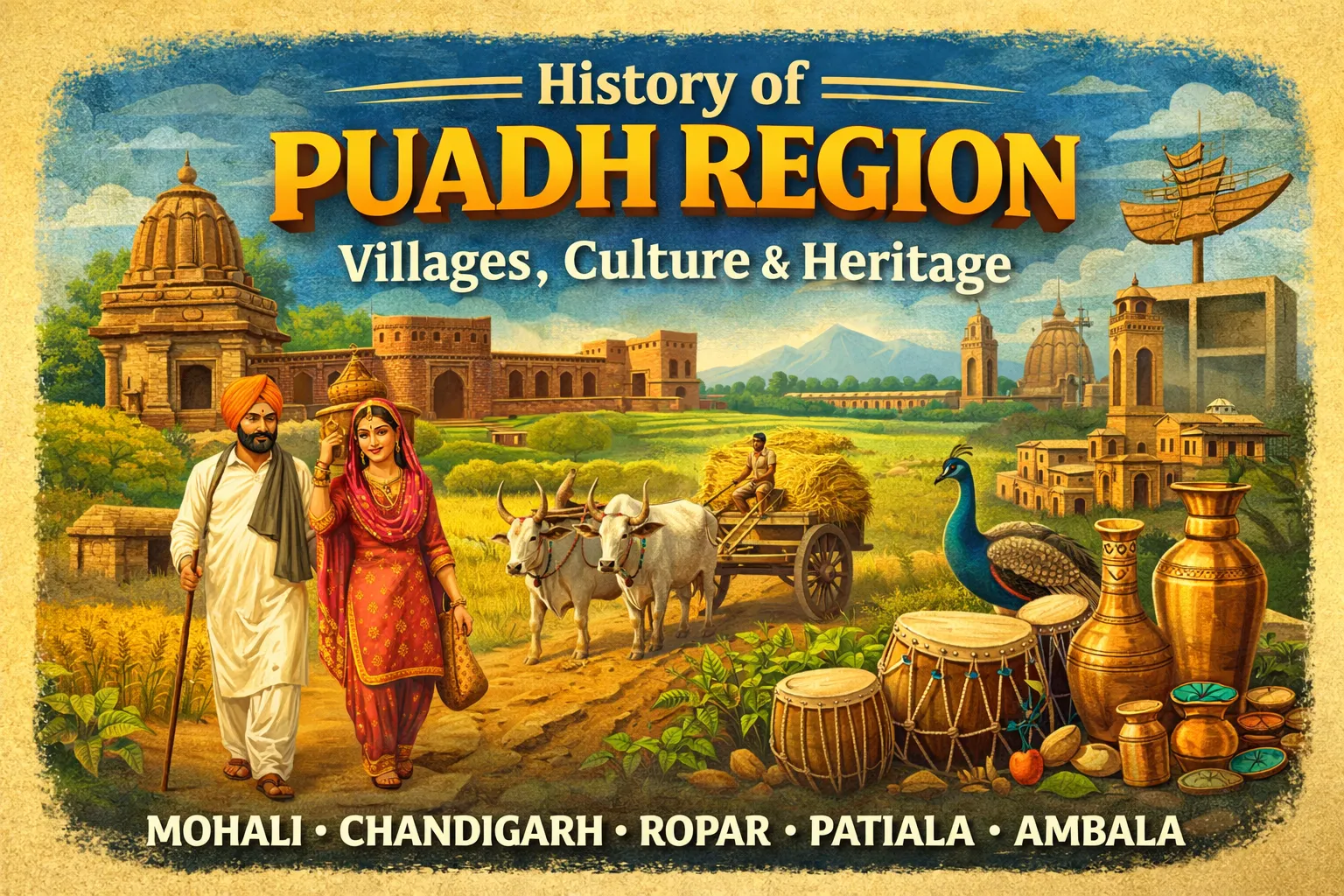
Open Google Maps. Drop a pin somewhere between Chandigarh and Ambala. Zoom in. See those tiny clusters of roads, those small names you've never heard — Bazidpur, Mattaur, Morinda, Khizrabad? That's Puadh. And every single one of those dots on the map has a story that's older than the country itself.
Most people know Punjab through Amritsar, Ludhiana, or Jalandhar. But the Puadh region — the belt stretching across Mohali, Ropar, Patiala, Chandigarh, and Ambala — has a culture, a dialect, and a village heritage that most Punjabis themselves don't know about.
I grew up in this region. I've walked these village roads, sat under their peepal trees, and listened to the elders talk about times when these fields were forests and these roads were footpaths. On the Puadh Punjabi Podcast, I've interviewed people from these very villages — entrepreneurs, artists, farmers, and freedom fighters' descendants.
This article is my attempt to document the famous villages of the Puadh region — their history, their people, and the quiet legacy they carry. Because if we don't tell these stories, nobody will.
- Mattaur — The Village That Became Mohali's Neighbour
- Morinda — Where History Lives on Every Street
- Rajpura — The Gateway Fort of Puadh
- Landran — From Fields to Future
- Khizrabad — The Ancient Riverside Settlement
- Mullanpur — The New Chandigarh with Old Bones
- Ambala's Border Villages — Where Puadh Meets Haryana
01. Mattaur — The Village That Became Mohali's Neighbour
If you've ever driven past the Mohali IT park on the way to Kharar, you've passed Mattaur without knowing it. Today, it sits sandwiched between Sector 70 and the new highway — but 30 years ago, it was pure farmland as far as your eyes could see.
Mattaur is one of those rare Puadhi villages that has transformed completely in a single generation. Where farmers once grew wheat and sugarcane, there are now apartment towers and co-working spaces. But talk to the old families — the Grewals, the Gills, the Sidhus — and they'll tell you about a time when the only sound at night was the neem tree rustling in the wind.
On Episode 19 of the podcast, Gurjeet from Mattaur shared something that stayed with me: "My ba ji used to say — 'Pehle matti di khushboo aundi si, hun concrete di aundi ae.' (Earlier the soil had a fragrance, now it smells of concrete.) But he also said — the village didn't die. It just changed clothes."
Gurjeet Mattaur spoke about what it means to grow up Puadhi in a village that's becoming a city — the identity crisis, the pride, and the bittersweet beauty of watching your pind transform. Listen to Ep 19 — Punjabi Singers te ਪੁਆਧ.
02. Morinda — Where History Lives on Every Street
Morinda (also called Bahlolpur in old records) isn't just a village — it's a historical landmark of the Puadh region. Located on the Chandigarh–Ludhiana highway in Ropar district, this town has witnessed events that shaped Punjab's destiny.
In 1704, Guru Gobind Singh Ji passed through this region after the Battle of Chamkaur. The local Gurudwara marks the spot where the Guru's horse is believed to have paused. For the people of Morinda, this isn't history from a textbook — it's a living memory that gets passed from generation to generation.
The old part of Morinda still has haveli-style homes with carved wooden doors and inner courtyards — a dying architecture that you won't find in any new construction. If you walk through the purana sheher (old city) early morning, you'll hear Puadhi being spoken exactly the way it was 100 years ago.
If you're driving from Chandigarh to Ludhiana, skip the highway dhaba. Take the Morinda bypass exit, find a local tea stall near the old gurudwara, and ask the uncle making chai about the town's history. You'll get a free history lesson better than any museum.
03. Rajpura — The Gateway Fort of Puadh
Rajpura sits at the exact point where the Puadh region begins — the gateway between Punjab and Haryana, between the Malwa belt and the Puadh heartland. And it has the fort to prove it.
The Rajpura Fort (also called the Mughal-era fort) was a strategic military post for centuries. It changed hands between Mughal governors, Sikh misls, and eventually the British. Today, parts of the fort still stand — weathered, cracked, but unbroken. Just like the town itself.
Rajpura is also where you hear the cultural blend of Puadh most clearly. The dialect here has hints of both Punjabi and Haryanvi — a linguistic cocktail that exists nowhere else. You'll hear someone say "ki haal ae?" (Puadhi) and two minutes later "kaise ne?" (Haryanvi influence) — and neither sounds out of place.
04. Landran — From Fields to Future
Twenty years ago, Landran was a quiet village outside Mohali where farmers grew basmati rice and nobody had heard the word "startup." Today, it's home to Chandigarh University, one of the largest private universities in the region, with 50,000+ students from across India.
The transformation of Landran is perhaps the most dramatic in all of Puadh. In a single generation, it went from a pind where the biggest event was the annual mela at the local gurudwara — to a bustling education hub with cafés, hostels, and traffic jams.
The tension between old and new is palpable here. On one side of the road: a 200-year-old well where women once drew water. On the other: a glass-fronted building where students study artificial intelligence. Both are real. Both are Landran.
Villages like Landran are losing their architectural heritage at alarming speed. Old havelis are being demolished for commercial buildings. The village pond (khoo) has been filled. The cobblestone streets are gone. Once these structures disappear, they're gone forever. Preservation isn't about stopping progress — it's about remembering who we are while we progress.
05. Khizrabad — The Ancient Riverside Settlement
Tucked along the banks of the Sutlej river in Ropar district, Khizrabad is one of the oldest settlements in the Puadh region. Its name is derived from Khizr — the patron saint of water and rivers in Sufi tradition — which tells you everything about its origins. This was a river village. A water village. A village that existed because the Sutlej was here.
Before the Bhakra Dam was built and the river's flow was regulated, the Sutlej would flood every monsoon — and Khizrabad's people adapted. Their homes were built on elevated platforms. Their agriculture was flood-responsive. Their entire culture was shaped by the river's rhythm.
Khizrabad is the kind of place that makes you slow down. There's no rush here. The river sets the pace. And in an era where every village is trying to become a city, Khizrabad is content just being itself.
06. Mullanpur — The New Chandigarh with Old Bones
Everyone knows Mullanpur as "New Chandigarh" — the shiny new urban project being built across the border from the UT. Billboards advertise luxury flats. Brochures promise "the future of living." But long before the real estate developers arrived, Mullanpur was a significant Puadhi village with deep roots.
The name itself comes from Mullan — a term for the learned or the religious — suggesting that this village was once a centre of learning or spiritual practice. Old residents speak of a pathar wala khooh (stone well) that was the centre of village life for centuries, and a banyan tree so old that nobody remembered when it was planted.
Mullanpur represents the central tension of the Puadh region: how do you build the future without erasing the past? The answer isn't to stop development. It's to build with memory. To name the new roads after the old families. To keep the stone well as a monument, not fill it with concrete. To remember that before it was "New Chandigarh," it was someone's pind.
07. Ambala's Border Villages — Where Puadh Meets Haryana
The eastern edge of the Puadh region bleeds into Haryana — and the villages around Ambala City are where this cultural blending becomes beautiful, confusing, and utterly unique.
Villages like Dhulkot, Shahzadpur, Ramgarh, and Saha exist in a linguistic no-man's-land. The elders speak Puadhi. The youth switch between Punjabi, Haryanvi, and Hindi in a single sentence. The food is a mix — sarson da saag meets bajra ki roti. The music? Both Sidhu Moosewala and Haryanvi ragini play at the same wedding.
These villages are the most "endangered" part of Puadhi culture. Because they fall in Haryana administratively, they don't get counted as "Punjabi" in census data. Their dialect doesn't appear in Punjabi language studies. Their history gets filed under "Haryana heritage" even though it's fundamentally Puadhi.
Culture doesn't follow state borders. The Puadhi dialect doesn't stop existing just because a map says "Haryana." These border villages are proof that the Puadh region is bigger than any boundary line — and that our roots run deeper than any government can define.
Why These Villages Matter More Than Ever
In 2026, we're building smart cities, launching satellites, and talking about AI. But the foundations of everything we are — our language, our food, our values, our identity — were laid in these villages. In the wheat fields of Mattaur. In the gurudwara lanes of Morinda. In the river ghats of Khizrabad. In the old havelis of Rajpura.
Every time a village loses its old well, its stone house, its elder who remembers the stories — we lose a piece of ourselves that no museum can recreate. Documentation is preservation. And that's exactly why I started the Puadh Punjabi Podcast — to record these stories before they disappear.
If your pind is in the Puadh region — whether it's one of these seven or a hundred others — it matters. Its story matters. And if you want to tell that story to the world, come to our studio in Mohali. We'll help you record it. For free if the story is good enough.