
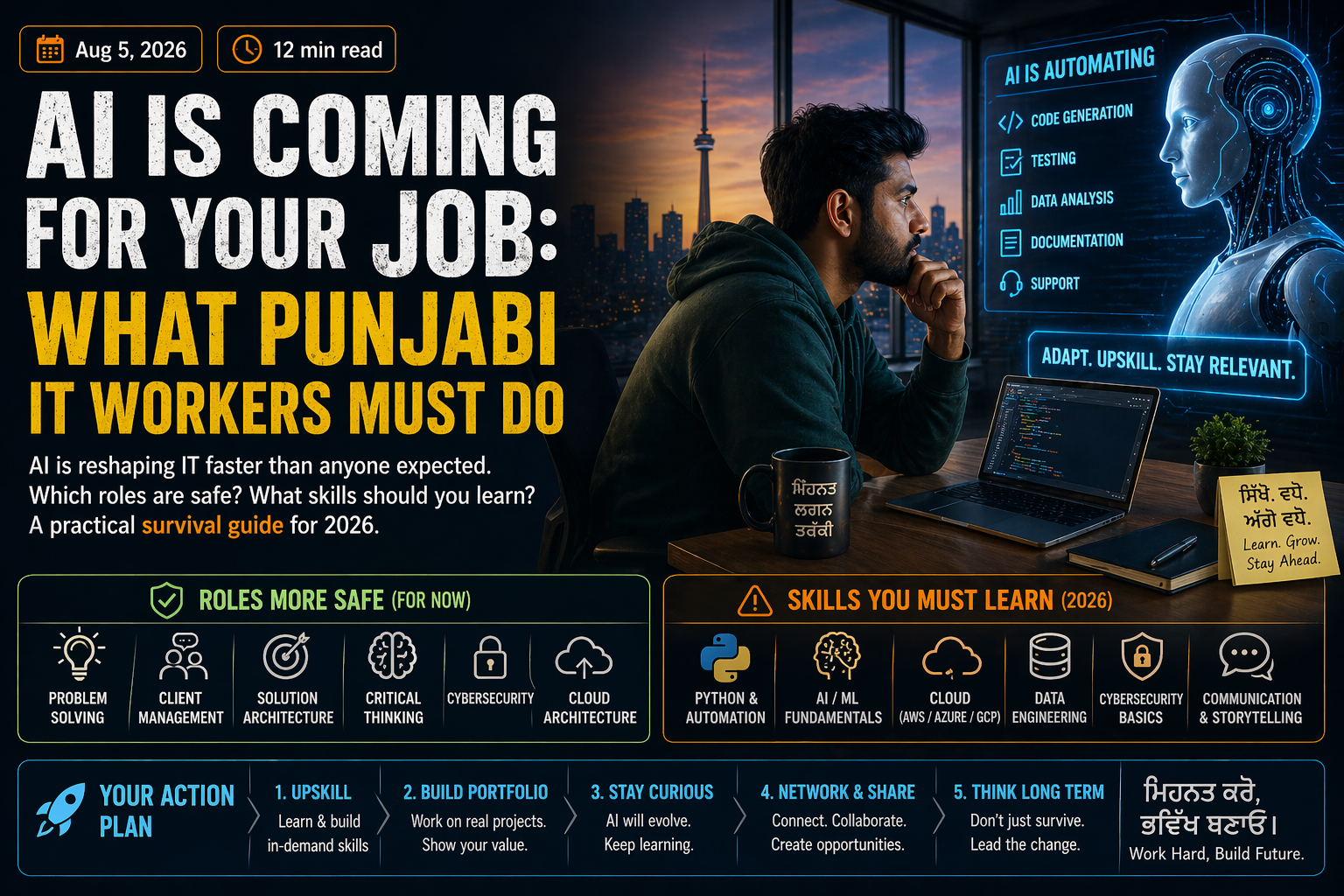
In 2024, a software engineer at Infosys Chandigarh told me something I haven't forgotten: "Gurinder, I used to write 500 lines of code a day. Now GitHub Copilot writes 400 of them. I'm just the reviewer." He wasn't complaining. He was scared.
He should be. We all should be.
The AI revolution isn't coming — it's already here. And the Mohali–Chandigarh IT corridor, home to 50,000+ tech workers, is sitting directly in its path. From Phase 8 to Rajiv Gandhi Chandigarh Technology Park (RGTCP), from Infosys to Net Solutions to the hundreds of startups in between — nobody's job is 100% safe.
But here's what nobody's telling you: AI isn't going to destroy IT. It's going to reshape it. The people who adapt will earn more than ever. The people who don't will be replaced — not by AI itself, but by someone who knows how to use AI better than them.
This article is your survival guide. I've spoken to CTOs, hiring managers, and AI engineers across the Tricity on the Puadh Punjabi Podcast. Here's what they said — and what you need to do right now.
01. The Reality Check: What AI Has Already Changed
Let's start with numbers, not opinions.
According to the 2026 NASSCOM report, 38% of entry-level coding tasks across Indian IT companies are now assisted or fully handled by AI tools. That's not a future projection — that's today. Right now. While you're reading this.
Here's what that looks like on the ground in Mohali:
- Code writing: Junior developers at Tricity firms are using Copilot, Cursor, and Claude to generate boilerplate code, APIs, and database schemas. What used to take 3 days now takes 3 hours.
- Testing: AI testing tools (like Testim, Mabl, and Playwright with AI plugins) have reduced QA team sizes by 25–40% at several Mohali companies.
- Content & documentation: Technical writers, SEO executives, and social media managers are being replaced by ChatGPT workflows. One person + AI now does what 4 people used to.
- Customer support: AI chatbots handle 60–70% of Tier 1 queries at Chandigarh-based SaaS companies. The remaining 30% go to a smaller, more skilled team.
- Design: Midjourney, Figma AI, and Canva's AI tools have decimated the "basic graphic designer" market. If you only know Canva, you're in trouble.
If your job is 90% repetitive, rule-based, and predictable — coding standard features, writing routine tests, creating basic designs, doing data entry, writing generic content — AI can already do it. Not "will be able to." Already. The only reason you still have that job is that your employer hasn't figured out the AI workflow yet. They will. Probably this year.
02. Job Risk Meter: Where Do You Stand?
I've rated the most common IT roles in the Mohali–Chandigarh area by their AI replacement risk. These ratings are based on conversations with local hiring managers, NASSCOM data, and what I'm seeing on the ground in the Tricity IT market.
AI can generate 80%+ of standard UI components, forms, dashboards, and landing pages. Junior devs who only convert Figma to code are already being replaced at Tricity agencies.
AI testing frameworks can now write, execute, and maintain test cases autonomously. Manual QA is declining faster than any other IT role in the region.
AI generates social media posts, banners, thumbnails, and basic brand assets in seconds. Only designers with strong brand strategy, motion, or UX skills are safe.
AI writes SEO articles, meta descriptions, and social captions at scale. What's valuable now is content strategy, not content production.
AI handles CRUD APIs and boilerplate well, but architecture, security, performance optimization, and complex business logic still need humans. The role shrinks — but doesn't disappear.
AI can query databases, generate charts, and surface insights. But interpreting business context, communicating findings to non-technical stakeholders, and making strategic decisions? Still human territory.
AI assists with Infrastructure-as-Code and monitoring, but cloud architecture, security, cost optimization, and incident response require deep expertise that AI can't replicate yet.
The people building AI are the last ones AI will replace. Demand for ML engineers in Mohali has grown 3x in 2025–2026. If you're here, you're not just safe — you're in demand.
03. The Roles That Are Actually Safe (For Now)
Let's be honest — "safe" is relative. But these roles have the strongest defences against AI replacement in the Mohali–Chandigarh market:
🏗️ System Architects & Tech Leads
AI can write code. But it can't decide which code to write, why a microservices architecture is better than a monolith for this specific client, or how to migrate a 10-year-old legacy system without breaking everything. Architecture is judgment, not just knowledge. And judgment is still human.
🔒 Cybersecurity Professionals
As AI gets better at attacking systems, the demand for people who can defend against AI-powered attacks is exploding. Mohali companies are struggling to hire security engineers — and paying ₹15–25 LPA for mid-level roles. This gap will only widen.
📊 Data Engineers (Not Analysts — Engineers)
Building data pipelines, managing ETL workflows, ensuring data quality at scale — this is infrastructure work that AI can assist with but can't own. If you're building the pipes that AI drinks from, you're indispensable.
🗣️ Product Managers & Business Analysts
AI doesn't understand what a client in Phase 8 actually wants when they say "thoda sa aur interactive karo" (make it a bit more interactive). Translating vague human desires into technical requirements — that's a deeply human skill.
🤖 AI/ML Engineers & AI Product Builders
The obvious one. But here's the less obvious part: you don't need a PhD. Many of the highest-paid AI engineers in Mohali right now are self-taught developers who spent 6 months learning prompt engineering, RAG systems, and LangChain. The barrier to entry is lower than you think.
Notice the pattern? Safe roles involve decision-making, complexity, human communication, security, or building the AI itself. Unsafe roles involve repetition, predictability, and transforming one format into another (Figma → code, SQL → chart, brief → article). Move your career toward the first group.
04. 5 Skills That Will Save Your Career
I asked every tech guest on the podcast: "If you were 25 again, starting in Mohali IT today, what would you learn?" Here are the 5 answers that came up again and again.
Everyone uses ChatGPT. But can you build a workflow where AI writes code, another AI reviews it, a third AI writes the tests, and you just approve the final output? That's AI tool mastery — and it's worth ₹5–10 LPA more than regular development.
Start with: GitHub Copilot (free for students), Cursor IDE, Claude API, LangChain. Build one internal tool for your current company using AI. That one project on your resume > any certification.
AI writes functions. Humans design systems. The jump from "developer" to "architect" is the single most valuable career move in the AI era. Architects earn 2–3x what coders earn — and AI makes them more productive, not less.
Start with: Read "Designing Data-Intensive Applications" by Martin Kleppmann. Watch architectural case studies on YouTube (ByteByteGo, System Design Interview). Practice by designing systems on paper before coding them.
Every company in Mohali is asking: "How do we add AI to our product?" They need people who can deploy AI models on AWS/GCP, set up vector databases, build RAG pipelines, and integrate LLMs into existing apps. This skill combination is the hottest in the Tricity market right now.
Start with: AWS Bedrock or GCP Vertex AI free tier. Deploy one AI-powered feature (even a simple chatbot with company-specific knowledge). Put it on your LinkedIn. Watch the recruiters flood in.
This is the skill nobody in Mohali talks about — and it's the one that separates the ₹8 LPA developer from the ₹25 LPA tech lead. AI can't explain technical trade-offs to a non-technical client. AI can't negotiate a project timeline. AI can't calm down an angry stakeholder. Soft skills are the hardest skill to automate.
Start with: Volunteer to present your team's work to clients. Write technical blog posts (even internal ones). Join a Toastmasters club in Chandigarh. Practice explaining complex things simply — that's the #1 skill that gets you promoted.
A doctor who knows AI will replace a doctor who doesn't. A finance expert who uses AI will replace a finance expert who doesn't. The pattern: Domain expertise + AI literacy = unstoppable. Pick an industry (healthcare, real estate, agriculture, education) and become the person who applies AI to that specific domain.
Start with: Look at Punjab's biggest industries — agriculture, real estate, education, healthcare. Pick one. Learn its pain points. Build a small AI tool that solves one problem. You're now not "just a developer" — you're an agri-tech AI specialist or a health-tech AI builder. That niche is your moat.
05. What This Means for Mohali & Chandigarh Specifically
Let's get local. Because the AI impact in Mohali isn't the same as in Bangalore or San Francisco. The Tricity has its own unique dynamics.
The Good News
- Mohali is becoming an AI hub. Companies like Net Solutions, Sebiz, and Quark are actively building AI product teams. New AI startups are opening offices in Phase 8B and IT City.
- Cost advantage. Mohali-based AI engineers cost 3–5x less than their US counterparts. Global companies are increasingly hiring here for AI roles — not decreasing.
- Chandigarh University and Chitkara are launching dedicated AI/ML programs. The talent pipeline is growing.
- Government push. Punjab's 2026 IT policy includes incentives for AI-focused companies setting up in the Mohali IT City.
The Bad News
- Service companies will shrink teams. The Infosys, TechMahindra, and Convergys offices in the Tricity employ thousands in repetitive roles — BPO, basic testing, data entry, junior support. These teams will be cut by 30–50% over the next 2–3 years.
- Freelancers are hit first. Mohali has a huge freelance community (web dev, design, content). AI is devastating the low-end freelance market. Clients who paid ₹15K for a website now ask: "Why can't I just use AI?"
- Training gap. Most Mohali IT workers haven't touched an AI tool beyond ChatGPT. The gap between "I know AI exists" and "I can build with AI" is massive — and growing.
The Tricity isn't going to lose IT jobs overall — it's going to shift them. The 1,000 manual QA jobs that disappear will be replaced by 400 AI-augmented QA engineer roles. The question isn't "will there be jobs?" — it's "will you qualify for the new ones?"
06. Your 90-Day Action Plan
Enough analysis. Here's exactly what to do — starting this week.
Days 1–30: Audit & Awareness
- Day 1: Write down every task you do at work for one full week. Be honest.
- Day 7: Highlight every task that is repetitive, rule-based, or involves transforming information from one format to another. Those are your AI-vulnerable tasks.
- Day 10: For each vulnerable task, research one AI tool that can do it. Try it. Time yourself vs. the AI.
- Day 15: Pick one skill from the 5 above. Just one. Don't try to learn everything.
- Day 30: Complete one small project using that skill. A GitHub repo. A blog post. A tool you built. Anything tangible.
Days 31–60: Build & Share
- Day 31: Start building your "AI portfolio" — a single page (Notion, GitHub Pages, whatever) that showcases what you've built with AI.
- Day 40: Introduce one AI workflow at your current job. Even something small — automated code reviews, AI-assisted testing, AI-generated documentation. Show your boss the time/money saved.
- Day 50: Post about what you're learning on LinkedIn. Weekly. Not "hustle culture" posts — real, specific, technical posts. "I built a RAG chatbot for our internal docs using LangChain + GPT-4. Here's what I learned."
- Day 60: You should now have: 1 AI project, 1 AI workflow at work, and 4+ LinkedIn posts. That's more than 90% of Mohali IT workers.
Days 61–90: Position & Pivot
- Day 61: Update your resume. Reframe your role: "Frontend Developer" → "Frontend Developer with AI Integration Experience." Add specific AI tools you've used.
- Day 70: Apply to 5 companies that are building AI products (not just using AI). Check Wellfound, LinkedIn, and the Mohali Startup Scene group.
- Day 80: Attend one local tech meetup or event in Chandigarh/Mohali. Meet people who are already working with AI. Your network is your net worth.
- Day 90: Assess. Did you get callbacks? Did your current company value your AI initiative? What skill gaps remain? Plan your next 90 days accordingly.
You don't need to become an AI engineer in 90 days. You need to become the person in your team who understands AI — the one others come to with questions. That position alone — being the AI-knowledgeable person in a room full of AI-ignorant people — is worth more than any certification, any degree, any bootcamp.
Final Word: Fear Is Optional, Action Is Not
I'm not going to sugar-coat this. AI is going to eliminate jobs in Mohali. It's going to eliminate jobs in Chandigarh, in Ropar, in Patiala — across the entire Puadh region. Some of you reading this will lose your current role within 24 months.
But here's the other side: AI is also going to create jobs. Higher-paying jobs. More interesting jobs. Jobs that didn't exist 3 years ago — AI product manager, prompt engineer, AI integration specialist, AI-augmented developer. The money isn't disappearing. It's moving.
The question is simple: are you going to be the person who loses a job, or the person who gains one?
The answer depends on what you do in the next 90 days. Not next year. Not "when I get time." Now.
If this article woke you up — good. Now do something about it. And if you want to talk about your career, your skills, or your AI journey on the Puadh Punjabi Podcast, reach out. We'd love to have you on the show.